20×24 Studio, the Home of Large Format Instant Photography
It has been two years since 20x24 Holdings LLC took possession of the film inventory and production equipment required for large format 20x24 instant film from Polaroid Corporation. In that time we have set up production facilities in Dudley, Massachusetts and a inventory spooling and pod production facility in Putnam, CT. We continue to offer access to this venerable technology through our rental studio at 75 Murray Street in the Tribeca neighborhood of New York City as well as the 20x24 Studio West in San Francisco. Film is also available to owners of 20x24 instant systems through direct sales. The New York Studio and 20x24 Holdings LLC is managed by Executive Director John Reuter. His experience spans nearly thirty five years in large format instant photography. In 2012 the 20x24 Studio will expand with two new cameras and a second NYC studio at the Film Society of Lincoln Center. For further information e-mail us at105,110,102,111,64,50,48,120,50,52,115,116,117,100,105,111,46,99,111,109moc.oiduts42x02@ofni or call 212-925-1403.
When did the 20×24 Project begin? 1976, when Polaroid at Dr. Land’s direction built the first functioning prototype. This camera was used to take portraits at the 1976 Polaroid Shareholder’s meeting.
Why did Polaroid build such a camera? To demonstrate the quality of Polacolor II Film. Polaroid was about to release a professional color film in 8×10 format.
When were the 20×24 cameras built? In 1977 and 1978, Polaroid’s metal and wood working shops built 5 cameras under the direction of John McCann of Vison Research.
What were the cameras used for? Polaroid built a studio on Ames Street in Cambridge, MA. This studio contained two studios and a gallery to exhibit the images. Initially, they invited a number of select photographers to experiment with the cameras, in exchange for donating images to the Polaroid Collection. Polaroid also used a process camera version to copy paintings in the 40×80 studio at the Museum of Fine Arts in Boston. Cameras were also sent to Amsterdam and Tokyo.
Where are the cameras currently located?
There are two cameras in New York City. One is at our flagship studio at 75 Murray Street. The second, on temporary loan from 20×24 Studio West, is at a studio at the Film Society of Lincoln Center. The third is owned by Elsa Dorfman and is in Cambridge, MA. The fourth is owned by Jan Hnizdo in Prague, Czech Republic. The fifth is being operated by Impossible Works in Paris. France. A sixth camera, one of the original five is now in the Harvard Museum of Scientific Instruments. It was a retirement gift to Edwin Land in 1982 and was part of Land’s Rowland Foundation bequeathment to Harvard University. The 20×24 Studio West camera is not one of the original five, but rather an earlier prototype with a new front end built by Wisner Manufacturing and customized by Mammoth Camera.
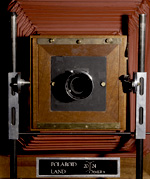
What are the specifications of the camera? The 20×24 camera is a traditional view camera, but has hybrid characteristics of a rail camera and field camera. It weighs 235 pounds and sits on a rectangular frame on wheels that supports a two-column studio stand. The bellows is driven by a telescoping nylon gear that allows bellows extension from 17’’ to 60”. The front standard has 24” of rise and fall, 6” of side to side shift and the ability to swing 4” forward and back. The rear standard of the camera is static and has no independent rise and fall separate from the camera itself. The camera can descend to 24” and rise to a height of 72”. The camera rear box contains a built in processor with 22’ titanium rollers. It is driven by a geared motor drive powered by a 110v AC motor. Transformers are used for 220 or 240v current.
How is the film put in the camera?
20×24 film is provided on rolls. The negative is supplied as a 150’ roll and sits on brackets at the top of the camera box. The positive is on a 50’ roll and sits on a similar bracket at the bottom of the processor. There are no sprockets in the film and it is moved into position with tab connected to string with adhesive tape. This simple solution was utilized early on and has never been improved on. Above the positive roll in the camera sits a tray that through a chain driven system moves the chemical reagent pods into position between the two rollers where the negative and positive meet.
The 20x24 Camera and Processing Back
Camera in Tilt Mode/ Bellows extended
Camera in Swing Mode/ Processing Back
Where do you get your film?20×24 Holdings purchased over 500 cases of film in raw stock form from Polaroid Corp.in 2009. The negative is kept in cold storage at 38º and the positive is stored in a climate controlled space at 45% relative humidity. The chemicals that make up the reagent are stored in component form and only mixed when needed. Once placed in a pod, the reagent will begin to age.
Ted McLelland, John Boudrow, Rob Young and Tom Silva, are Team 20x24 Holdings. They are shown here with the reagent reactor.
What is a pod? A pod is a foil packet with special seals designed to break under pressure when passing through rollers, allowing the reagent to spread evenly between the negative and positive rolls and begin the development process. How are the pods made? The pods are produced on a special machine, the only remaining one in the US (Polaroid nice had dozens of pod machines in their US factories). It is housed in our warehouse in Putnam, CT.
The Pod Machine, built in 1956 in 20x24 Holdings Putnam, CT facility.
How often do you make pods? It is based on demand, so far it is four or five times per year.
What kind of film do you have left? We have Polacolor ER, which was sold by Polaroid as T669, T59, and T809. It is also referred to as P3. This film was a favorite of photographers making Image Transfers and Emulsion Lifts. It has a rather subdued color palette and is excellent for portraits. Our other color film is Polacolor 7, and was sold as T690 by Polaroid. It has a brighter color palette, more contrast and is similar to Fuji FP100C in performance. It is excellent for fashion and still life, many photographers prefer it for portraiture as well. Finally we have Polapan 400, our Black and White emulsion. It provides beautiful grayscale transitions, has excellent contrast and is also a favorite of portrait photographers. It is the film we are in shortest supply of and will look to find a replacement in 2012 and 2013.
Will you ever produce your film in smaller format? That is something we are actively looking into.
Here is a video on the pods being made in 2010. Roy Johnson, Marc Soufrant, and Ted McLelland produced the run.
The birthplace of Polaroid to host first screening of a captivating documentary directed by Polaroid photographer Grant Hamilton.
BOSTON (April 11, 2012) – Tickets go on sale today for “TIME ZERO: the last year of Polaroid film,” a documentary that chronicles the death — and rebirth — of instant film. The documentary is an official selection of the highly acclaimed Independent Film Festival Boston. Polaroid artists, former employees of the corporation, and photography enthusiasts from around the globe are planning to attend the world premiere of the documentary on Saturday, April 28, 2012 at 12:30pm in the historic Somerville Theatre. A Question & Answer session featuring Director and Polaroid photographer Grant Hamilton will take place after the screening. “We’re thrilled to be premiering ‘TIME ZERO’ in Boston because it was the birthplace of Polaroid,” said the movie’s director, Grant Hamilton. An award-winning photographer whose favorite camera is a 1970s-era Polaroid SX70, Hamilton was inspired to make the film after Polaroid announced the discontinuation of instant film in 2008. “The death of Polaroid instant film marked the end of an era and left thousands of photographers without an alternative. This was a story that needed to be told.” “TIME ZERO” starts as a eulogy to Polaroid instant film and cameras, sharing with viewers the magic of Polaroid through the perspective of a few Polaroid artists and former employees of the corporation. After documenting the fateful day when Polaroid announced it would cease production of instant film, “TIME ZERO” shares the intense emotions of several photographers — including filmmaker John Waters — as they recount hearing the news…and then focuses on a few dedicated individuals who decide to start a grass-roots effort to keep instant film alive. The documentary chronicles the passionate efforts of a small team who – against all odds – tried to keep instant photography alive.
The documentary’s web site is www.timezeromovie.com. Information on the movie can also be found on FaceBook (facebook.com/TimeZeroTheMovie) and Twitter (@TIMEZEROmovie).
The 10th Annual Independent Film Festival Boston, which takes place April 25-May 2, 2012, will screen a diverse slate of over 200 feature and documentary films and shorts. For more information, see the IFFB web site: http://www.iffboston.org/2012/index.php
On Friday, March 30, 2012, Lens featured a series of portraits from Mary Ellen Mark’s new book, “Prom,” with a clip from the accompanying film by Martin Bell. The portraits also appeared in the Sunday Review over the weekend. The images were made using the Polaroid 20×24 Land Camera and Polaroid PolaPan 20×24 film. In our conversation last week, we asked Ms. Mark about the camera. Featured here is a selection of additional images she has made using the 20×24.
Read the full story here.
The We Are Family Foundation (WAFF) is an American501(c)(3) nonprofit organization founded in 2001 by songwriter, musician, and producer Nile Rodgers in the wake of the September 11, 2001 attacks. Its mission is dedicated to the vision of a global family by creating and supporting programs that inspire and educate people about mutual respect, understanding, and appreciation of cultural diversity – while striving to solve some of our biggest global problems at the same time.
The foundation began on September 22, 2001, when Rodgers and Tommy Boy Music president Tom Silverman brought 200 musicians, celebrities, and personalities together in New York City and Los Angeles to re-record Rodgers’ hit song “We Are Family” (best known in its 1979 hit version performed by Sister Sledge) to start the healing process after the events of September 11. DirectorSpike Lee filmed the “We Are Family” music video, and director Danny Schechter filmed a documentary entitled The Making and Meaning of We Are Family, which depicts the recording session. The documentary was chosen as a Sundance Film Festival Special Selection in 2002.
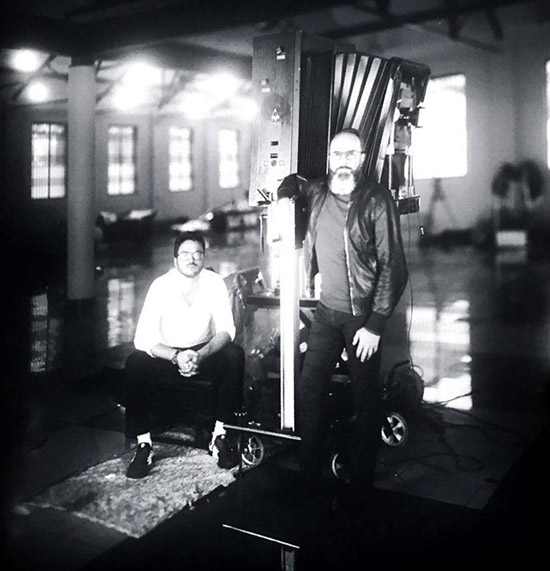
The hulking dinosaur of a camera that photographer Elsa Dorfman has based her career on for over 30 years could soon become extinct. Dorfman, now 74 and living in Cambridge, was first introduced to the 20″x24″ Polaroid in 1980. She had been invited by the company to try one of the 240-pound behemoths that had originally been built in 1976. Simply referred to by the size of the prints it makes, the 20×24 was like a much larger version of the Polaroid cameras most people were familiar with (the camera and Dorfman are pictured above). It only took a few shots to get her hooked.
“From the minute I used it I loved it,” she says.
by John Reuter
no comments